Social Freezing

Thanks to cutting-edge medical advancements, it is now possible to safely and effectively freeze eggs and sperm. At the 360° Fertility Center, we offer secure cryopreservation, allowing you to protect your fertility and choose the right time to start your family. Social freezing acts as a backup plan—an egg reserve that you can access if needed, but are never obligated to use. Our experienced specialists provide expert and compassionate guidance on this option.

Photo

Why Consider Social Freezing?

Health Reasons

Health Reasons

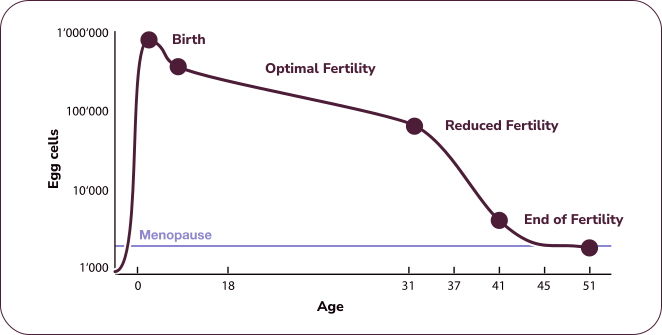
You are born with all the eggs you will ever have. However, as you age, genetic changes and external factors can impact egg quality. Before 35, the chances of a healthy pregnancy are significantly higher. Social freezing allows you to preserve high-quality eggs for the future.

Career & Personal Timing

Career & Personal Timing

You know that you want children one day, but the timing isn’t right due to your career, studies, or life circumstances. While biology doesn’t wait, our specialists can’t slow down the biological clock—but we can help you outsmart it.

Avoiding Egg Donation

Avoiding Egg Donation

At a certain age, natural conception rates decline, and egg donation may be the only option—but in Switzerland, this is legally prohibited. Many patients also prefer to conceive with their own eggs. Social freezing allows you to be your own egg donor in the future.

Take Control of Your Family Planning

Modern cryopreservation techniques make it possible to store eggs and sperm safely for years. Many women find it reassuring to know that they have this option—without the immediate pressure of conceiving.

A simple blood test measures your anti-Müllerian hormone (AMH) level, an important indicator of your ovarian reserve.

Tip: If you complete this test before your first consultation, it helps us provide a more detailed and efficient assessment.

During your first appointment, we discuss:

  • Your current fertility status
  • Your future family planning goals
  • Realistic success probabilities based on your age and hormone levels

Fact: The younger you are and the more eggs we retrieve, the higher the success rates for future pregnancies.

To maximize the number of eggs retrieved, a short hormone therapy is used to stimulate egg production.

The retrieved eggs are immediately frozen at -196°C using liquid nitrogen and securely stored.

Storage duration: 5 years (with the option to extend for another 5 years)

When the time is right, your eggs can be fertilized through IVF and transferred to your uterus. If the first attempt isn’t successful, previously frozen eggs allow for further tries without the need for additional stimulation.

Protect Your Young, Healthy Eggs Today...

At 25 years old, you have more healthy eggs than later in life. Since fertility declines with age, freezing eggs earlier increases the chance of a successful pregnancy in the future.


...To Be Prepared for Tomorrow

After 35, the chances of conceiving naturally decrease significantly. By freezing your eggs at a younger age, you preserve their quality, ensuring you have viable eggs when you're ready to start your family.


Frequently Asked Questions (FAQ)

Social Freezing involves retrieving unfertilised eggs and gently freezing them (cryopreservation) to preserve them for a future wish to have children. The number and quality of eggs naturally decline over the years – particularly from around the age of 35. Freezing eggs earlier creates a reserve of younger, healthier eggs. Social Freezing therefore buys time and flexibility, without guaranteeing a later pregnancy.

Both procedures are technically similar but differ in their indication: Medical Freezing involves freezing eggs for medical reasons – for example, before chemotherapy, in cases of endometriosis, ahead of planned surgery, or when the egg reserve is declining prematurely. Social Freezing, on the other hand, is a precautionary measure taken without an acute medical event.

Social Freezing may be a good option for women who – for personal, professional, or relationship reasons – are not yet ready to have a child but want to keep the option open. According to studies, the following life situations are frequently mentioned by interested women:

  • They are currently not in a relationship
  • They are going through a period of change, such as after a separation
  • The relationship is still new and family planning together is not yet in sight
  • They and their partner are not yet at the same point when it comes to having children

Social Freezing may also be worth considering before ovarian surgery or in cases of early menopause running in the family. As a general rule: the earlier the eggs are retrieved, the better their quality tends to be. Whether it is the right choice for your situation is something we are happy to discuss in a personal consultation.

Between the ages of 25 and 35, your eggs are in peak condition and plentiful. If you are in this age range and considering Social Freezing, this is a good time to explore it more closely. As illustrated in the graph above, the success of IVF depends above all on the age of the egg used: success rates halve between the ages of 35 and 40 alone and decline further significantly thereafter. Donated eggs from younger women (shown in blue), however, retain a high potential.

From a medical perspective, egg retrievals before the age of 35 therefore tend to yield the best results. Social Freezing is also possible after this age – but the chances of success per egg decrease as age increases. The best way to protect your fertility is to freeze your young, healthy eggs now and preserve their quality – so that you can be your own egg donor when the time comes. We are happy to provide an individual assessment – based in part on your AMH level (a measure of your egg reserve) – in a personal consultation

How many eggs to freeze is a highly individual question. It depends on your age, your personal starting point – including your egg reserve – and how many children you would like to have in the future. Not every egg will lead to a baby, regardless of age. However, the more eggs are preserved and the younger you are when they are frozen, the higher the likelihood of a future pregnancy. For example, a woman aged 34 with 6–7 frozen eggs has approximately a 50% chance of having a baby using those eggs, while the same number of eggs at age 39 gives a probability of around 26%. A larger number of eggs therefore increases the chances of a later pregnancy; this often requires more than one stimulation cycle.

It is worth distinguishing between three questions:

How many eggs should be frozen?
All eggs that have developed and matured following hormonal stimulation are frozen.

How many eggs develop?
This depends on your biological starting point – specifically, your individual egg reserve, which varies considerably from woman to woman.

How many eggs should you aim to freeze?
This depends on your specific goals. We can assign a realistic probability of pregnancy – and even of a live birth – to any number of eggs. Within certain limits, a target range can be defined, and it can then be calculated whether this is achievable in one or more cycles, and with what degree of confidence.

The question of how many eggs to aim for can feel overwhelming at first. In practice, it is often best to start with one cycle, analyse the results carefully, and then decide whether further cycles make sense.


To prevent any mix-up of patient samples, 360° Kinderwunsch Zentrum Zurich uses the RI Witness system. Each sample container is coded with an RFID chip, allowing all activities and workflows in the IVF laboratory to be continuously monitored via an integrated antenna. If a sample appears on the work surface that does not belong to the current step, an alert is triggered automatically.

For the freezing process itself, we use an established, gentle method: vitrification. Frozen eggs generally survive storage very well. Social Freezing increases the chances of a later pregnancy, but does not guarantee it – success depends on factors including age at the time of freezing, the number and quality of the eggs, and the subsequent treatment.

In Switzerland, unfertilised eggs frozen for non-medical reasons (Social Freezing) may be stored for a maximum of ten years under the Reproductive Medicine Act – five years with a one-time extension of a further five years. Different rules apply when there is a medical indication.

Social Freezing is a self-pay service; basic health insurance does not generally cover the costs. We offer two options:

Social Freezing Subscription: treatment at a guaranteed fixed price – from CHF 99 per month (360° Basis package) or CHF 169 per month (360° Rundum package), paid in interest-free monthly instalments. You know from the outset exactly what it will cost.

Self-pay rate (private rate): based on actual costs and individual – the price range for a Social Freezing treatment is approximately CHF 3,000–6,000, plus medication and storage. All amounts quoted in advance are non-binding estimates.

Medical Freezing for medical reasons is different: in this case, basic health insurance covers the costs under certain conditions.

Everything begins with a personal initial consultation, during which we take the time to discuss your situation, your questions, and the expected costs – at your pace. Get in touch with us; we are here for you.

AMH (Anti-Müllerian Hormone) is primarily a quantitative marker that gives an indication of how many eggs are likely to mature during hormonal stimulation. The number of eggs retrieved in turn plays a significant role in determining the success of a future treatment.